Thursday, November 14, 2013

Expert Assessment: Ocean Acidification May Increase 170 Percent This Century


"Nov. 13, 2013 — In a major new international report, experts conclude that the acidity of the world's ocean may increase by around 170% by the end of the century bringing significant economic losses. People who rely on the ocean's ecosystem services -- often in developing countries -- are especially vulnerable."


A group of experts have agreed on their ‘levels of confidence’ about ocean acidification during the Third Symposium on the Ocean in a High CO2 World in September 2012. The summary will be revealed in November 18, 2013. Experts agree that ocean acidification will affect marine life and subsequently lead to human consequences as well, specifically in economic losses because of a decline in shellfish.

Ulf Riebsel, one the lead coauthors of the summary, says that if we continue to emit CO2 the way that we do now, we must prepare for economic and ecosystemic losses. But, if the rate of CO2 gas were reduced, then this would slow acidification. An outcome that was emphasized was that the erosion of coral reefs could outpace the building of coral reefs this century. Another outcome is that coral reefs in the deep sea may become unsustainable. Wendy Broadgate mentions that there are many other consequences that the use of CO2 brings along. For example warming and deoxygenation are caused by a rise in CO2 emissions. She stresses that it is important to use less CO2 gas, but this will not make the ocean better; there are other problems such as overfishing.


There are three levels of confidence about the effects of ocean acidification, very high confidence, high confidence, and medium confidence. This is a summary from the article:


Very high confidence
• Ocean acidification is caused by carbon dioxide emissions from human activity to the atmosphere that end up in the ocean.
• The capacity of the ocean to act as a carbon sink decreases as it acidifies
• Reducing carbon dioxide emissions will slow the progress of ocean acidification.
• Anthropogenic ocean acidification is currently in progress and is measurable
• The legacy of historical fossil fuel emissions on ocean acidification will be felt for centuries.

High confidence
• If carbon dioxide emissions continue on the current trajectory, coral reef erosion is likely to outpace reef building some time this century.
• Cold-water coral communities are at risk and may be unsustainable.
• Molluscs (such as mussels, oysters and pteropods) are one of the groups most sensitive to ocean acidification.
• The varied responses of species to ocean acidification and other stressors are likely to lead to changes in marine ecosystems, but the extent of the impact is difficult to predict.
• Multiple stressors compound the effects of ocean acidification.

Medium confidence
• Negative socio-economic impacts on coral reefs are expected, but the scale of the costs is uncertain.
• Declines in shellfisheries will lead to economic losses, but the extent of the losses is uncertain.
• Ocean acidification may have some direct effects on fish behaviour and physiology.

• The shells of marine snails known as pteropods, an important link in the marine food web, are already dissolving.

Sunday, November 10, 2013

'Tiger Stripes' Underneath Antarctic Glaciers Slow the Flow

Just as no-slip strips on floors prevent people from slipping on a wet floor, "tiger stripes", named after Princeton's tiger mascot, do the same. Tiger stripes are narrow stripes of dirt and rock underneath glaciers in the Antarctic , these stripes create areas of friction that reduce the speed of the flow of ice toward the sea. Researchers at Princeton University and the British Antarctic Survey have worked to understand how these stripes form; this information could also aid researchers in understanding how the flow of these glaciers reacts to a warming climate.

Researchers want to understand what helps to determine the flow of glaciers, to do this they studied two glaciers, the Pine Island Glacier and the Thwaites Glacier in West Antarctica. These two glaciers together contribute to about 10% of the recorded sea-level rise in the past 20 years, according to the researchers the Pine Island Glacier moves at a velocity of about 1.5 miles per year.

Researchers run into a problem when trying to study these tiger stripes, studying the bottom of these glaciers is almost impossible because the ice is too thick to see through; the glaciers are over a mile-and-a-half thick. Instead, the researchers use satellite to measure the ices velocity and they use ground-penetrating radar to detect bedrock and surface topography. Using the data collected, the researchers created a mathematical model that calculated what happens inside the glacier as it flows along the bedrock, this model actually predicted the tiger stripes.

The friction is a major factor in the speed of a glacier, when friction is high, the glacier moves slowly and when friction is low, the glacier moves more quickly. The tiger stripes, lie at 30-degree angles along with the direction of the glacier's movement. These stripes form and decay due to a natural processes that occurs over 50 to 100 years, the process is strongly affected by how water, goes through the space between the ice sheet and the bedrock. "The ribs may play an important role in buffering the effects of a warming climate, since they slow the movement of ice that reaches the ocean and contributes to sea-level rise… These changes can happen independently of climate change," said by one of the researchers. Although more investigations are needed to verify models of rib formation, they guess that the tiger stripes are related to landforms that exist in the areas of North America and Europe.


Sources:
http://images.sciencedaily.com/2013/11/131108091341-large.jpg

Friday, November 1, 2013

Is Global Heating Hiding out in the Oceans? Parts of Pacific Warming 15 Times Faster Than in Past 10,000 Years

"Oct. 31, 2013 — A recent slowdown in global warming has led some skeptics to renew their claims that industrial carbon emissions are not causing a century-long rise in Earth's surface temperatures. But rather than letting humans off the hook, a new study in the leading journal Science adds support to the idea that the oceans are taking up some of the excess heat, at least for the moment. In a reconstruction of Pacific Ocean temperatures in the last 10,000 years, researchers have found that its middle depths have warmed 15 times faster in the last 60 years than they did during apparent natural warming cycles in the previous 10,000."


In the most recent report that was released in September, the UN’s Intergovernmental Panel on Climate Change (IPCC) shared that there has been a slowdown in global warming. Each decade from 1950-1990, the temperature increased by 1/5th of a degree Fahrenheit. After 1998, a very hot year, the warming rate lowered by half. The IPCC says that it’s because “the pause to natural climate fluctuations caused by volcanic eruptions, changes in solar intensity, and the movement of heat through the ocean”. The IPCC believes that the ocean has collected much of the green house gas that humans have put into the atmosphere but findings in Science think of the long-term consequences of this. Yair Rosenthal, a Rutgers University scientist, says that the oceans may be storing more of the effects of human emission than we think. He says the ocean’s absorbing the effects may slow down climate change but not stop it.

Buoys that are placed all over the ocean measure ocean heat. Instruments from ships are also lowered to record temperatures. Another method that is used is the analysis of the chemistry of ancient marine life. Over the last 10,000 years the climate has been pretty stable. In the last 60 years though, from the surface of the Earth to 2,200 feet, the climate has increased 0.18 degrees Celsius, which might seem small but this rate of increase is 15 times fast than any period throughout the last 10,000 years.

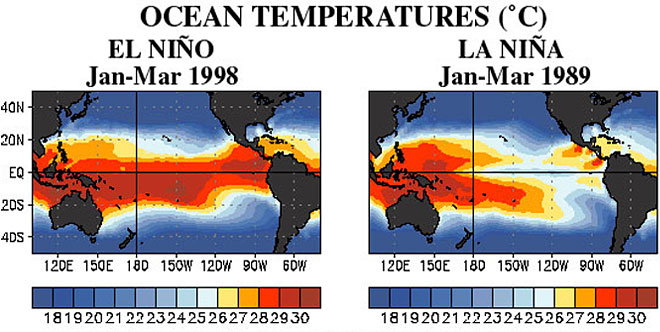
One explanation for the recent slow down in climate warming is because there might be a La Niña-like cooling in the eastern Pacific waters. Climate modelers from Scripps Institution of Oceanography demonstrated that la Niña cooling seems to slow down during the winter in the northern hemisphere but it allows for the waters to really become warm during the summer. “When the La Niña cycle switches, and the Pacific reverts to a warmer than usual El Niño phase, global temperatures may likely shoot up again, along with the rate of warming.” Global temperatures do not steadily raise, instead Kevin Trenberth, a climate scientist at the National Center for Atmospheric Research, describes it as walking up a staircase for 10 years and then you have a jump in which things are never the same like before. Drew Shindell, a climate scientist who works at Columbia’s Earth Institute and the NASA Goddard Institute for Space Studies, believes that looking at surface temperature may not be as useful as looking at stored energy by the climate system.

Sources: